
ResistorsAvailable
Ohm's Law Calculator
Calculate voltage, current, resistance, and power from any two known values.
Calculator category
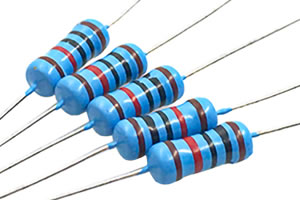
Resistor calculators support practical electronics engineering work such as DC circuit design, current limiting, voltage scaling, power dissipation checks, and resistor network analysis. These tools help hardware engineers and PCB designers validate component values, estimate operating margins, and troubleshoot circuits before moving into schematic review or board layout.
Available Calculators
6
Engineering Applications
4
Each listed tool links to a working calculator with engineering inputs, formulas, examples, notes, and related resources.
Calculate voltage, current, resistance, and power from any two known values.
Decode 4-band, 5-band, and 6-band resistor values, tolerance, and temperature coefficient.
Decode 3-digit, 4-digit, R notation, decimal, and EIA-96 SMD resistor markings.
Calculate output voltage, reverse-solve resistor values, divider current, and power dissipation.
Calculate equivalent resistance for dynamic series and parallel resistor networks.
Calculate LED current-limiting resistance, E24 selection, and resistor power rating.
Choose the calculator that matches the decision you need to make: decode a component marking, size a value, check a frequency response, estimate loss, or verify a safety margin. A category page is useful only when it helps you reach a working tool, so this page lists released calculators only.
Calculator results depend on unit choices, idealized formulas, tolerance, temperature, frequency range, and component limitations. Review the formula and engineering notes on each calculator page before using the result in a schematic, BOM, or PCB layout.
Use the calculated value as a design reference, then confirm it against datasheets, derating curves, layout parasitics, measurement conditions, and manufacturer limits. The related guides below provide background when a calculation needs more context.
Engineering Guide
Learn how to identify resistor values using 4-band, 5-band, and 6-band resistor color code systems.
10 min · Beginner
Engineering Guide
Learn how IEC preferred resistor values such as E3, E6, E12, E24, E48, E96, and E192 simplify circuit design and component selection.
10 min · Beginner
Engineering Blog
Avoid common BJT circuit design mistakes including incorrect base resistors, insufficient base drive, hFE assumptions, saturation errors, thermal problems, bias instability, and pinout mistakes.
15 min · Intermediate
Engineering Blog
Avoid common LED design mistakes including missing current control, incorrect resistor values, excessive current, forward-voltage assumptions, resistor power errors, thermal problems, brightness comparison errors, and improper LED driving.
14 min · Intermediate
Engineering Blog
Avoid resistor selection errors involving power rating, tolerance, temperature coefficient, package, voltage rating, noise, and long-term stability.
11 min · Intermediate
Engineering Blog
Learn how to choose the right resistor E-Series by balancing tolerance, precision, cost, availability, and circuit requirements.
12 min · Intermediate
LED calculators for indicators, LED strips, high-power LEDs, RGB lighting, and current limiting.
Open →Power electronics calculators for regulators, converters, thermal design, current estimates, and hardware margins.
Open →Use electronics conversion tools for frequency and period, AWG wire gauge, dBm and watts, hexadecimal, decimal, binary, and engineering workflows.
Open →